
Berkshire County Wanted Sources
The Berkshire County Sheriff's Office has no standing most-wanted page. Its navigation, forms, news archive, and Useful Links show no public warrant roster either. So no public list exists in those places. Active warrants can still be plentiful. The state's Warrant Management System is real, but it lives inside justice and law-enforcement channels. It is not a public sheriff search tool.
Need a statewide option? The Massachusetts State Police Most Wanted page is the official fallback. It posts a selective group of serious fugitive notices, some with photos. It is not a Berkshire County list by any stretch. Entries shift as cases move, and a card may linger with a captured label. The agency's own advice stands: report, never act on your own.
Berkshire Wanted Notice Fields
Provenance comes first. Ask who issued the notice and when it went out. An official card may sketch both the person and the reason for the alert, while an event release might stay narrow and spare. Fill in nothing that is not there. A last-known place says nothing about where someone is today, and the date on a notice is just the date of the notice.
| Field | What it shows |
|---|---|
| Issuing agency | The office responsible for that alert, such as State Police or BCSO. |
| Name and aliases | The identity terms reported by the agency for that notice. |
| Notice date | When the alert was posted, not proof that its status is current today. |
| Reported basis | The offense, warrant basis, escape, or other stated reason for seeking the person. |
| Official photograph | An agency-published identification image that remains on the source page. |
| Tip instructions | The approved phone or local-authority route and any do-not-approach warning. |
You may also see physical traits or a last-known area. Treat them only as material for a good-faith tip. Never post a home address or launch your own investigation. The official source owns the caution note and the current tip path.
Use Berkshire Wanted Notices
Keep the agency page at the center of everything. Screenshots, search snippets, and reposts can outlive the event long after it ends. A direct check also shows whether a card has been updated, marked captured, or quietly pulled.
- Open the current State Police wanted page or the dated BCSO notice.
- Confirm the agency, posting date, name, aliases, and stated reason.
- Read every caution and do-not-approach instruction on the source.
- If there is useful information, contact the exact official channel shown.
- For later custody or booking context, consult the Berkshire County booking-record guide.
Things move fast in these cases. A person can be sought, arrested, released, transferred, or brought before a court within days. A wanted list is not a custody locator. After an arrest, the trail shifts to a police record, a BCSO admission record, a court docket, or a state custody locator, depending on where the person ended up.
Berkshire Sheriff Alert Photos
One BCSO escape press release shows how the sheriff uses official photographs when public safety demands it. The dated release paired the image with a tip number and a plain instruction: do not approach. That alert belonged to a single event. It did not create a recurring mugshot gallery or a countywide wanted list.
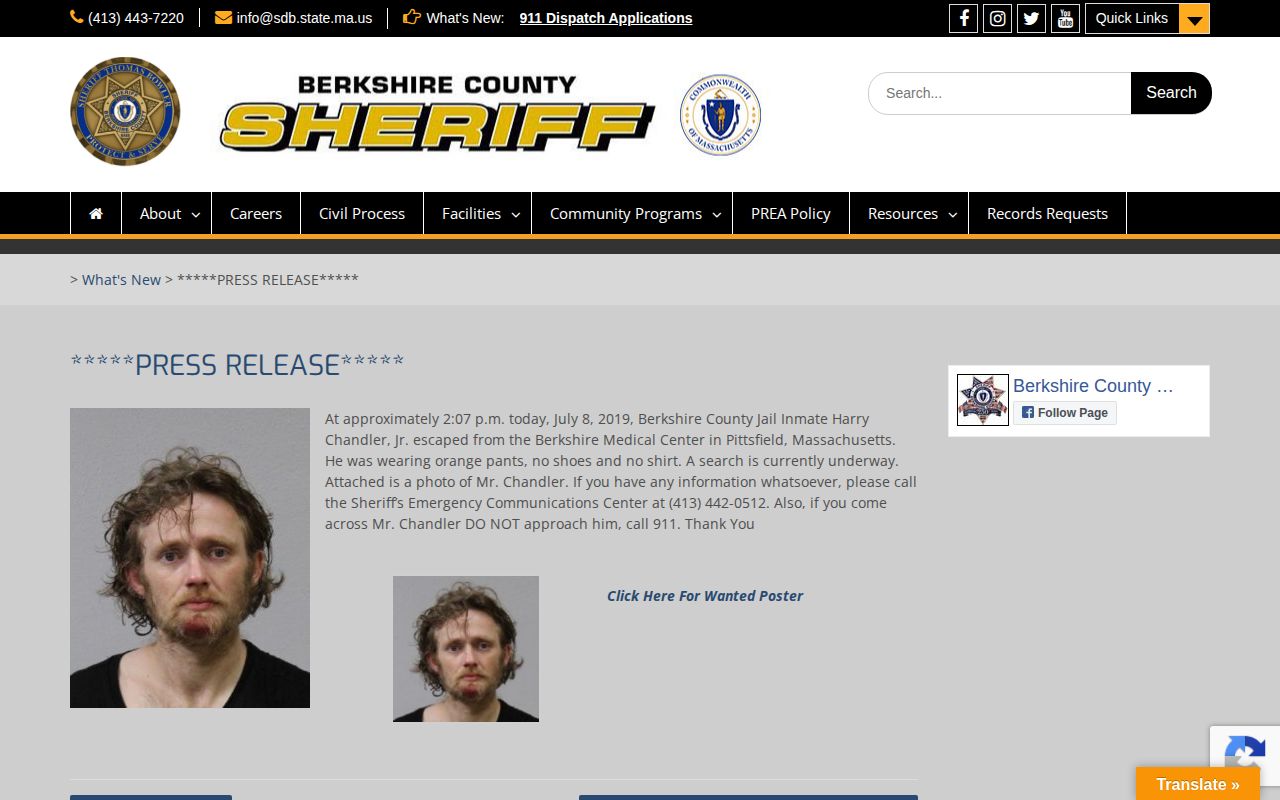
The pattern matters here. A photo belongs with its agency notice, its date, its warning, and its case context. Lift the image somewhere else and you risk detaching it from a capture update or a later court event. Before relying on an alert, return to the live agency page.
The sheriff's official Facebook, Instagram, X, and YouTube accounts do carry episodic notices. There is no routine booking app or verified weekly warrant feature, though. Whenever a social post traces back to an underlying BCSO release, check it against the website. A social timeline is not a stable warrant database.
Check Berkshire County Warrants
The Warrant Management System holds official warrant data. Massachusetts General Laws chapter 276, section 23A spells out what belongs in it. No public Berkshire County portal reaches that system, though. Keep that gap in mind. A name missing from a wanted page or a web search proves nothing about current warrant status.
- Identify the court named in a dated police log, release, summons, or case paper.
- Contact that court clerk through its official Mass.gov page and ask for the safe way to verify status.
- Have a party name, date of birth, docket number, and case location ready if known.
- If the issue concerns the person asking, speak with a lawyer or the court about lawful resolution before appearing.
- Confirm any result with the court or authorized agency, not a news story or private search page.
Court geography shapes the search. Pittsfield District Court handles many central county cases. Northern Berkshire District Court serves North Adams, Adams, and nearby communities. Southern Berkshire District Court covers the southern towns. Berkshire Superior Court takes county matters within its jurisdiction. Which clerk is right depends on the case, not the person's home town.
No dedicated BCSO warrants-unit phone or email exists. Do not call the jail expecting staff to settle a court warrant question. Facing an emergency or immediate danger? Call 911. For a personal warrant concern, a court clerk or lawyer is the safe route, with no attempts to hide, flee, or dodge lawful process.
Berkshire Warrant Record Types
The word warrant covers more than one kind of court action. No public Berkshire list sorts them by type. So the issuing document and the clerk stay decisive. A few plain definitions help you ask the right question without guessing at an outcome.
| Record type | Meaning in a status check |
|---|---|
| Arrest warrant | A court order authorizing an arrest based on the case and request before it. |
| Bench warrant | A warrant issued by a judge, often tied to a missed court duty or order. |
| Warrant request | A reported application or request that should not be stated as an issued warrant without confirmation. |
| Dated wanted alert | A public notice asking for help that may summarize, but does not replace, current court status. |
Trial Court Rule 3 lays out how a warrant or summons is issued and executed. A summons asks someone to appear. That is not the same as a warrant. News stories often mention a warrant application before any court file is easy to find, so keep the verbs straight. Applied for, issued, served, recalled, and resolved are all different events.
Berkshire Wanted Tip Channels
Wanted tips for Berkshire County go through the State Police Violent Fugitive Apprehension Section. Local authorities can take a call too. One caution: the statewide list gets updated, so check the official page rather than a number you saved earlier. A stale phone line wastes time.
Inside Pittsfield, the CitizenObserver service takes anonymous city tips. It will not run a warrant search, though. The Berkshire County Sheriff's Office has no reward program and no guaranteed anonymous-reward process. So don't promise either anonymity or cash unless a current agency notice backs it up. Emergencies go straight to 911. For something less urgent, route the observation to whatever agency the alert names.
Verify Berkshire Wanted Status
Wanted information goes stale fast. The State Police page may carry a captured label. A sheriff post can linger in search results long after the event. A DA release may only note that police sought a warrant on a given date. Each document speaks only for the moment it covers. Turning any of them into a present-tense claim about someone would be a mistake.
A good verification note states what the source reported, gives its date, and names the office that can confirm the status today. If a public page vanishes, resist the urge to declare the warrant cleared. Cards come down for many reasons. Pages get redesigned all the time. The issuing court or an authorized law-enforcement office can give the real answer.
Once an arrest happens, the court docket takes over. There you can follow arraignment, amended charges, continuances, dismissal, plea, trial, or final disposition. An arraignment is the early hearing where charges are formally addressed. A disposition is the court's recorded outcome. Charges sometimes get reduced or dropped along the way.
Berkshire Wanted Social Alerts
The sheriff's office runs accounts on Facebook, Instagram, X, and YouTube. These can surface a dated public-safety post worth reading. What they won't give you is a tool. No sheriff app with a routine warrant or booking function exists, and there's no verified local "warrant Wednesday" series either. Think of each account as an occasional bulletin board. It is not a complete index.
Start with the BCSO Useful Links page when you wonder whether the agency has added something new. A social post linking to a release on the sheriff's own site points you to the source of record. Note its publication date plus any update. Images get shared and reshared. Along the way they can shed their caption, warning, tip number, and capture status. The original page holds all of that together.
State and city alert systems each cover their own turf. Massachusetts VINE handles state DOC custody details, not a county warrant list. Pittsfield's CitizenObserver takes tips, and the city offers emergency alert subscriptions. North Adams runs CodeRED, another emergency-warning service. Call none of them a countywide wanted database. Whenever you mention one, name the agency and its purpose.